
Game area
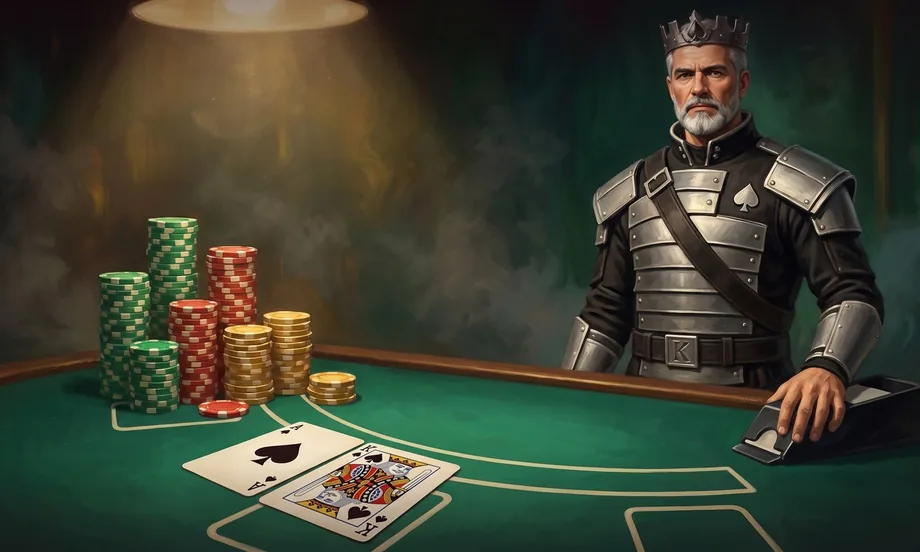
Blackjack 21
The game loads right here, no download.
Selminha standard: P pauses · M sound · SPACE or tap to startAbout Blackjack 21
It is plain old twenty-one, dealt at the King of Spades' table. Six decks in the shoe, a 5 to 500 table limit per hand, and 500 chips to start you off. Cards come out one at a time, the way they do at a real table: yours, the dealer's, yours, and the dealer's hole card — and only when you stand does that card turn over and the dealer play out the hand. Blackjack pays 3 to 2, insurance pays 2 to 1, and the dealer draws to 16 and stands on all 17s, soft 17 included. When you have had enough, CASH OUT gets you up from the table: whatever you walk away with is your score. Run the chips out and the night is over.
One of Selminha's ideas
“Blackjack is the casino game where the decision is really yours: the card is luck, but hitting or standing is a choice, and it is a choice you can do the math on. I wanted the table honest — six decks, real casino rules, no card quietly stacked for the house — and the house edge measured: with basic strategy it comes to 0.68%, which is what a good table gives you. What I did not want was cards appearing already dealt. Half the fun is watching the card come out of the shoe and turn over, yours and the dealer's. So the table deals in the right order and the result is only called once the last card has turned.”
How to play Blackjack 21, and when to hit or stand
- Tap the 5, 25, 100 and 500 chips to build your bet — 5 to 500 a hand — then DEAL. 'Repeat last bet' is on by default, so the next hand starts with the same bet already down.
- HIT takes another card; STAND passes to the dealer. Go over 21 and the hand is done.
- DOUBLE doubles your bet, gives you exactly one more card and ends the hand. First two cards only.
- SPLIT turns a pair into two hands, each with its own bet. You can reach 4 hands; split aces get one card each.
- When the dealer shows an ace you are offered INSURANCE: half your bet, paying 2 to 1 if the dealer has blackjack.
- CASH OUT walks you away with what you have — that is the number that goes on the leaderboard.
The rules at this table
- Blackjack pays 3 to 2
- An ace with a ten-card on the first two cards is a blackjack and pays one and a half times your bet. Blackjack against blackjack is a push and your bet comes back.
- The dealer stands on all 17s
- The dealer draws to 16 and stands on 17, soft 17 (ace counting eleven) included. There is no choosing — the rule is the same every hand.
- Six decks in the shoe
- The shoe holds six decks and is reshuffled once less than a quarter of it is left.
- Bets from 5 to 500
- The table limit here is 5 to 500 per hand. Doubling and splitting go past the cap — the limit is on the opening bet, the way it is at a real table.
Doubling, splitting and insurance
- Double down
- First two cards only: doubles the bet, gives you one more card and ends the hand. It is the move for a 10 or 11 against a weak dealer card.
- Split
- A pair becomes two hands, each with its own bet. Up to 4 hands. Split aces get one card each and stand.
- Insurance
- Offered when the dealer shows an ace: half your bet, paying 2 to 1 if the dealer has blackjack. Under basic strategy, insurance is not worth it.
- Cash out
- Gets you up from the table with the chips you have. That is the number that goes on the leaderboard — knowing when to leave is part of the game.
Controls on phone and computer
- Computer
- Tap the chips to bet · C hits · P stands · ↑ ↓ ← → move through the buttons · ENTER chooses · ESC pauses · M mutes
- Touch
- Phone upright and full screen — the table has two rows of cards with the printing on the felt between them, and sideways there is not enough height for all three. On a tablet the table follows whichever way you are holding it and never asks you to rotate; turn it mid-hand and the game pauses itself while the table is laid out again.
When to hit and when to stand
- Holding 12 to 16
- Look at the dealer's card: a 7 or higher and the dealer is likely to make a strong hand, so you have to take one. A 6 or lower and the dealer is the one likely to bust — let them.
- Holding 17 or more
- Stand. Little chance of improving, plenty of chance of busting.
- Holding 11 or less
- You cannot bust: take the card. With a 10 or 11 against a weak dealer card, double.
- Aces and eights
- Always split aces and eights. Never split tens: 20 is already a good hand.
Tell us what happened, or what you would change. The message goes straight to Selminha, and the reply comes to your email.
More games to discover
Your next discovery could be right here.

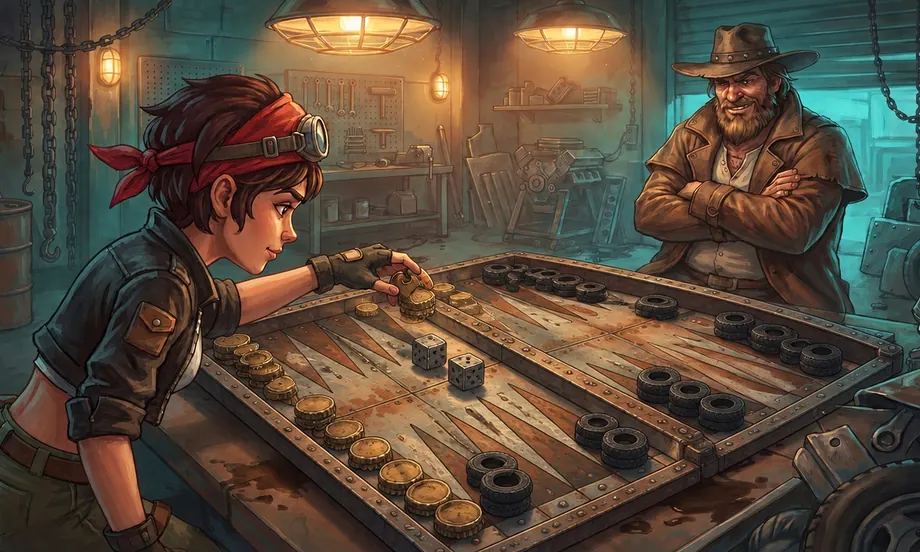
Backgammon
Scrapyard backgammon in Dália’s workshop: brass drum lids against tires on a steel-plate board, with dice welded from junk. Take on the four villains, from the Tamer (very easy) to the Executive (hard), or send someone a link and play whenever you can, each on your own device. Standard backgammon: 15 checkers a side, the bar, home board, bearing off, doubles and the must-use-both-dice rule. First to bear off all 15 wins.
Coming soon