
Game area
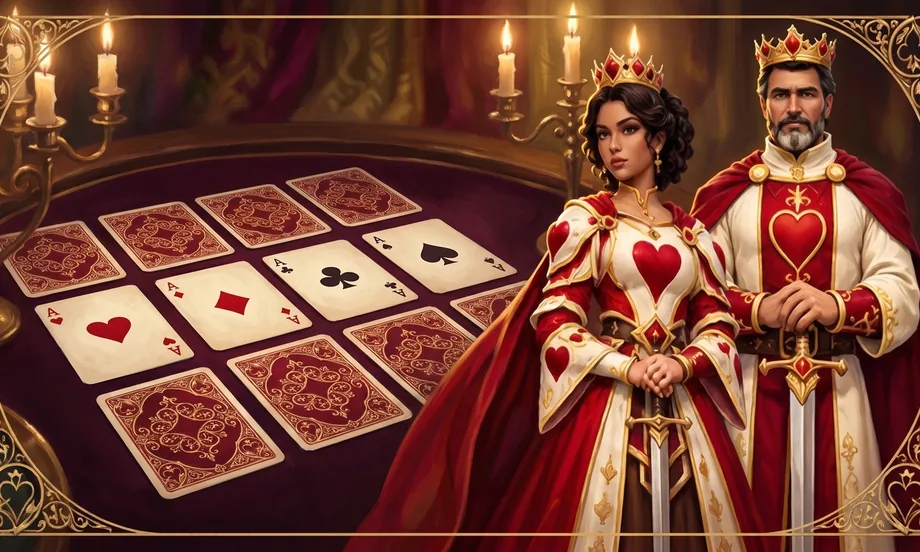
Solitaire
The game loads right here, no download.
Selminha standard: P pauses · M sound · SPACE or tap to startAbout Solitaire
It is the solitaire you have played your whole life, dealt on the council table of the Queen of Hearts. Three games share one deck: KLONDIKE, with seven columns, four piles from ace to king and a draw of one card or three; FREECELL, with all fifty-two cards face up from the start and four corners that hold one card each; and SPIDER, with ten columns, two decks and runs that leave the table once they close from king to ace. You pick the game, the difficulty and even the card design before you deal. The court cards are people from the kingdom — the Queen of Hearts, the Queen of Spades, the kings and the jacks, the same faces you meet in the other games of the series. Tap a card and it goes where it belongs; drag it if you would rather decide. HINT shows a move when the table locks up, UNDO takes the last one back. Clear the table and the time bonus puts you on the TOP 5.
One of Selminha's ideas
“Solitaire is the game you open when you want to think about something else, so I did not try to be clever with the rules: they are the ones every deck on every kitchen table already knows. What changed is the table. Instead of the green felt of an office computer, it is the council table of the Queen of Hearts, and the court cards are people from the kingdom — the same kings, queens and jacks you will run into in the other games. And since I was building one anyway, I built the three I actually play: Klondike to unwind, FreeCell to think, and Spider when I feel like picking a fight and nobody is around.”
How to play Solitaire, and tips for clearing the table
- Pick your solitaire in the menu: KLONDIKE, FREECELL or SPIDER. In Klondike you also choose to turn one card or three; in Spider, to play with one, two or four suits.
- Tap a card (or click it) and it finds the best spot on its own. To choose the spot yourself, drag the card to the column or the pile.
- In Klondike and FreeCell the columns run down in alternating red and black, and the four piles on top build from ace to king, one suit each. In Klondike, only a king opens an empty column.
- FreeCell has no stock: all fifty-two cards are already in sight. The four corners hold one card each, and they are what lets you move several cards at once.
- In Spider, close a run from king to ace in one suit and it leaves the table. Tap the stock to deal ten more cards — but no column may sit empty when you do.
- UNDO takes back the last move, HINT lights up a move you can make, and NEW GAME returns to the menu. On a computer, SPACE draws, Z undoes and D asks for a hint.
The three solitaires (pick one in the menu)
- Klondike
- Seven columns, four piles from ace to king, and a stock. Down the columns the cards alternate red and black, and only a king opens an empty column. Turn one card at a time (kinder) or three (the real table game).
- FreeCell
- Eight columns with all fifty-two cards face up and four corners that hold one card each. No stock, no luck: almost every deal can be solved, and finding the way through is the game. The more empty corners and columns you keep, the more cards you can move at once.
- Spider
- Ten columns and two decks. Close a run from king to ace in one suit and it leaves the table; eight runs clear the board. One suit is a stroll, two is work, and four is a proper fight.
True in all three
- Tapping
- One tap sends a card to the best spot; dragging lets you choose.
- Runs
- Only cards already in order travel together — alternating colors in Klondike and FreeCell, one suit in Spider.
- Undo
- Takes back the last move, as many times as you like. Nobody is watching.
- Hint
- Lights up a move you can make. When there is none, it says so.
Controls on phone and computer
- Computer
- Tap or click a card to send it on its way · drag a card to pick the spot · tap the stock to draw · SPACE draws · Z undoes · D asks for a hint · P or ESC pauses · M turns the sound on and off
- Touch
- Phone upright and in full screen. Tap a card to send it on its way or drag it to a column; the stock sits in the top corner. On a tablet the table follows the way you hold it: upright it plays like a phone, on its side like a computer, and turning it mid-game pauses on its own so the screen can settle.
Scoring
- Cards home
- 10 points for every card that reaches the piles (5 in Spider, which has twice the deck).
- Cards turned
- 5 points each time a face-down card opens.
- Going back
- Pulling a card off a pile back into a column costs 15 points.
- Time bonus
- Clear the table and you earn a bonus that shrinks the longer the game runs. Only a cleared table makes the TOP 5.
Tell us what happened, or what you would change. The message goes straight to Selminha, and the reply comes to your email.
More games to discover
Your next discovery could be right here.
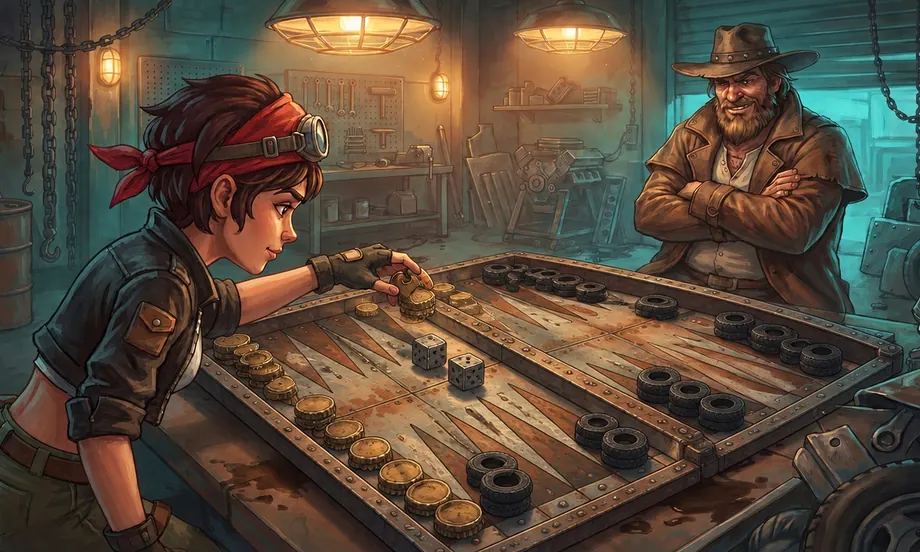
Backgammon
Scrapyard backgammon in Dália’s workshop: brass drum lids against tires on a steel-plate board, with dice welded from junk. Take on the four villains, from the Tamer (very easy) to the Executive (hard), or send someone a link and play whenever you can, each on your own device. Standard backgammon: 15 checkers a side, the bar, home board, bearing off, doubles and the must-use-both-dice rule. First to bear off all 15 wins.
Coming soon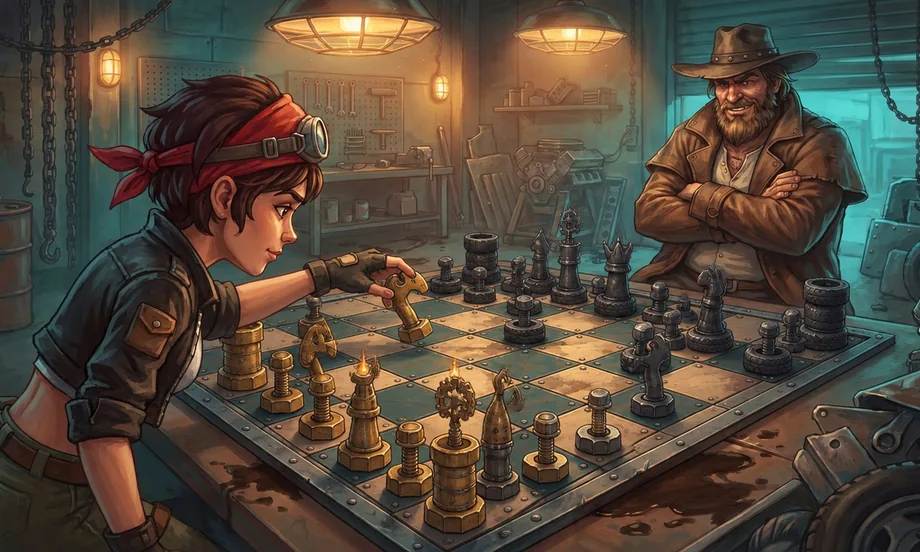
Chess
Scrapyard chess in Dália’s workshop: pieces welded from junk — brass against steel and tire rubber — on a rusty steel-plate board. Take on the four villains, from the Tamer (very easy) to the Executive (hard), or send someone a link and play whenever you can, each on your own phone. Full chess: castling, en passant, promotion, checkmate, stalemate and the draw rules.
Play